

2026-07-17
As a prime next-generation therapeutic target for obesity and metabolic disorders, GIPR belongs to the GPCR transmembrane protein family. It features unstable conformation, high screening difficulty, and inherent trade-offs between candidate molecular affinity and developability, making it a widely recognized challenging target for drug development in the industry. Developing a qualified anti-GIPR antibody via conventional technical routes typically takes 18–24 months and is plagued by three core industry pain points:
• Difficulties meeting affinity and cellular function
benchmarks:
Antibodies derived from traditional immunization and library screening exhibit
weak binding capacity and fail to match 2G10, the parent antibody of the
leading overseas candidate AMG133;
• Prolonged screening cycles:
Animal immunization plus multiple rounds of in vitro and in vivo optimization
and verification result in a full development cycle generally exceeding 18
months;
• Late exposure of developability defects: CMC
challenges including non-specific binding, high immunogenicity and propensity
for aggregation are only uncovered after molecular screening is completed,
rendering substantial upfront R&D investments futile.
Great
Bay Bio selected GIPR antibody design as a case study to validate the
capabilities of AlfaBodY, its proprietary AI-powered intelligent molecular
design platform. The full R&D workflow was completed within merely 8
months, with candidate molecules rapidly generated and validated via in vitro
and in vivo efficacy assays. This fully demonstrates the robust capability of
the AI platform to tackle challenging GPCR targets and rapidly generate
differentiated antibodies.
Relevant
platform research titled Generation of High-Affinity Anti-GIPR Antagonist
Antibodies with Sustained and Non-rebound Weight Loss in DIO Mice by AlfaBodY has been published on bioRxiv, the international preprint platform for
biomedical research. The paper comprehensively elaborates the standardized
end-to-end workflow of AlfaBodY, covering structural prediction, antibody
sequence generation and virtual screening, multi-layered in vitro screening,
and in vivo efficacy verification in obese animal models. This complete GIPR
antibody case verifies that the AlfaBodY AI antibody design platform can
efficiently conquer traditionally intractable GPCR targets and deliver a
replicable, high-efficiency new paradigm for novel antibody drug development.
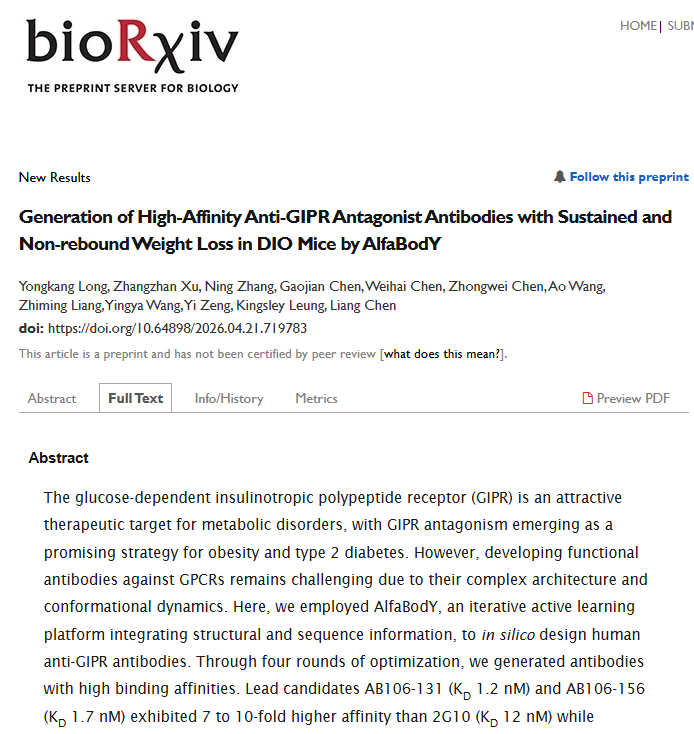
▲ Research outcomes of the AlfaBodY
platform are available on bioRxiv
Platform Case: High-Performance Validated GIPR
Molecules Generated in 8 Months
The
AlfaBodY platform drives the entire development workflow of anti-GIPR
antagonist monoclonal antibodies, accelerating the closed-loop process spanning
structural prediction, antibody design, multi-dimensional in vitro validation,
developability assessment and in vivo efficacy evaluation.
The
platform completed a full spectrum of tests including BLI/SPR affinity
measurement, cellular binding assays, cAMP functional tests, non-specific
binding assessment, developability evaluation, and in vivo efficacy studies in
DIO obese mice. Successful development of candidate molecules achieved an
effective breakthrough against this hard-to-drug GPCR target. Within 8 months,
the platform accomplished work that conventionally requires 18–24 months for
full GIPR antibody development.
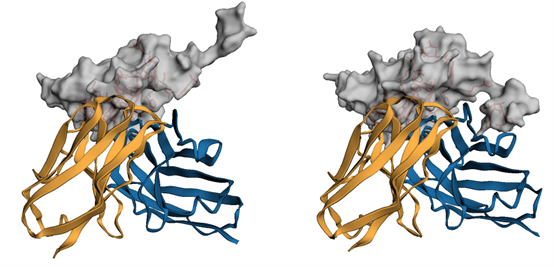
▲ Left and right panels show predicted
binding structures of candidate antibody molecules AB106-156 and AB106-131
bound to the antigen, respectively
AI-Directed Molecular Design Achieves Nearly 10-Fold
Affinity Improvement
Leveraging
atomic-level antigen-antibody binding simulation algorithms, AlfaBodY generates
antibody sequences targeting the extracellular domain of GIPR. Through four
rounds of AI antibody sequence generation, a total of 157 antibody molecules
were produced. High-affinity candidates were identified via wet-lab screening,
eliminating the need for massive random clone screening and enabling rapid
identification of potent candidates.
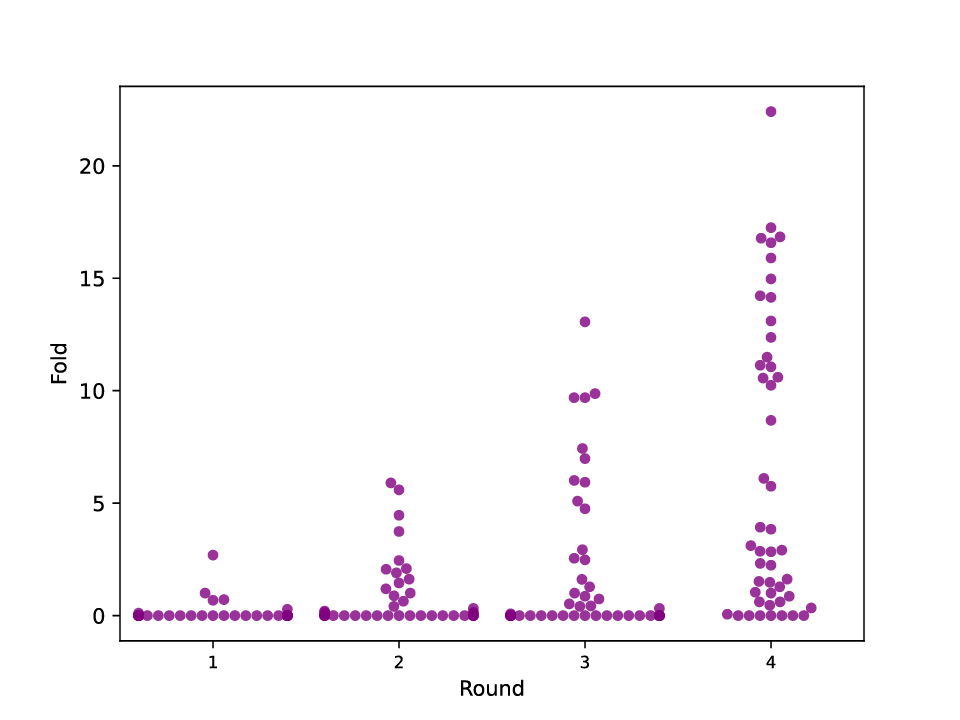
▲ The figure illustrates the binding
affinity ratio of antibodies generated in each design round relative to the
reference antibody 2G10. Binding affinity was markedly enhanced following four
rounds of optimization.
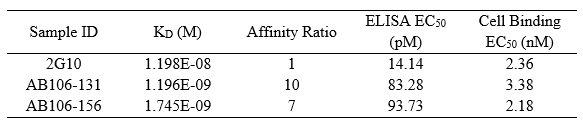
Affinity
measurements via bio-layer interferometry (BLI) show that AB106-131 exhibits an
affinity of 1.2 nM and AB106-156 reaches 1.7 nM, representing a 10-fold and
7-fold improvement over 2G10 respectively. Flow cytometry was used to measure
antibody binding to HEK293-T cells stably expressing GIPR (P48546). The EC₅₀
values of AB106-156, AB106-131 and 2G10 were 3.2 nM, 2.2 nM and 2.8 nM
correspondingly. A cAMP signaling reporter cell line constructed using
GIPR-overexpressing cells was adopted to evaluate antibody-mediated blockade of
the GIP/GIPR signaling pathway. The IC₅₀ values of AB106-156, AB106-131 and
2G10 were 5.9 nM, 4.4 nM and 4.0 nM. The two candidate molecules display
cellular binding and inhibitory function comparable to 2G10.
AI Explores Broader Sequence Space
Sequence
identity between the AI-generated antibody sequences AB106-131 / AB106-156 and
the parent antibody stands at 74.4% and 81.9%, while CDR region identity
reaches 71.7% and 75.0%. This confirms that AI can substantially expand
sequence diversity while boosting biological activity.

Pre-emptive Off-Target Risk Screening to Ensure Safety
AlfaBodY
integrates a built-in off-target binding prediction model to eliminate
sequences prone to non-specific binding at the molecular design stage.
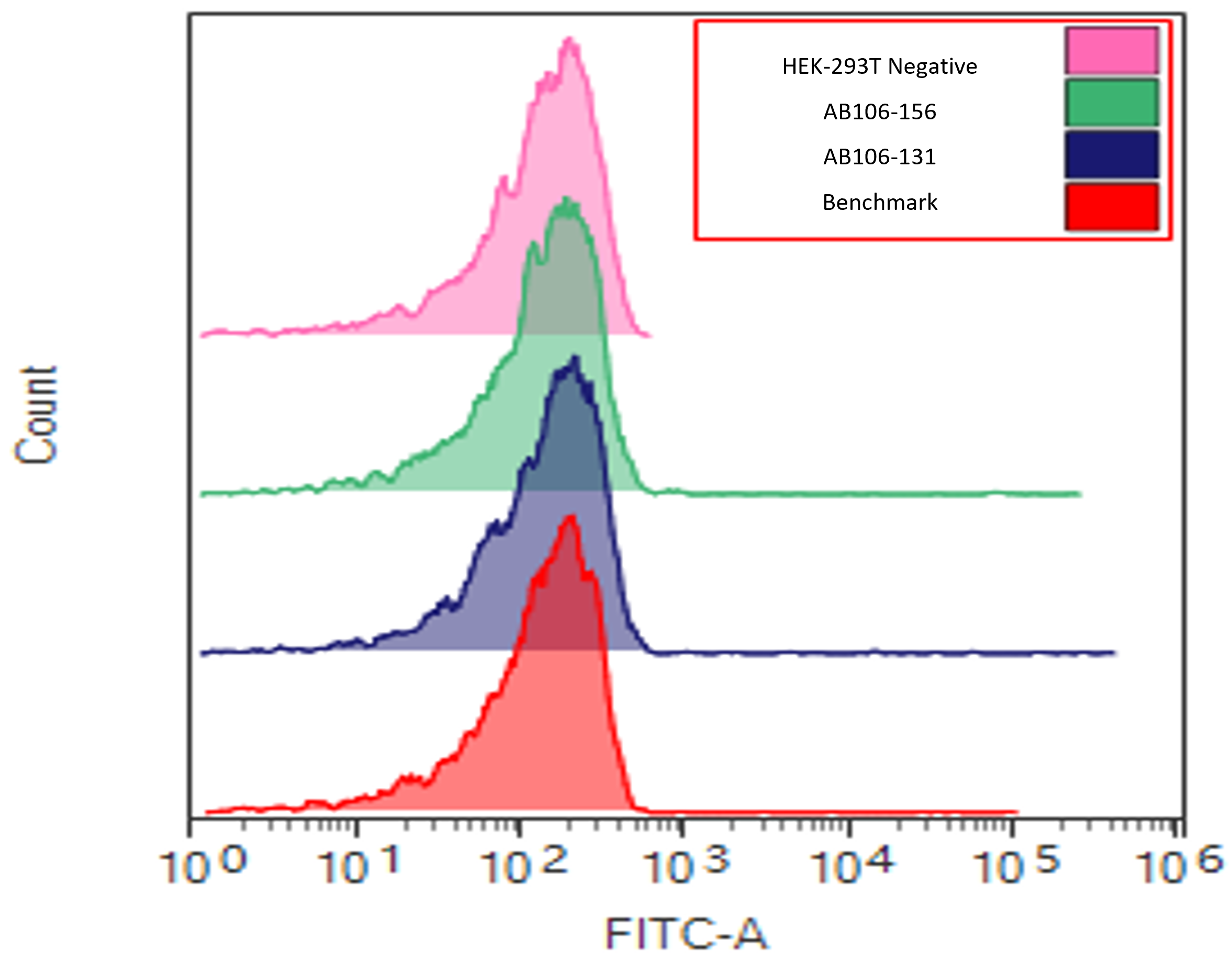
Subsequent FACS cellular assays corroborated the platform’s predictive results:
in tests on GIPR-negative HEK293T cells, the fluorescence MFI values of the
AB106 series matched those of blank PBS and benchmark control antibodies,
indicating zero risk of off-target binding. Developability is guaranteed from
the outset, avoiding repeated optimization and correction in later stages.
Synergy with AlfaDAX for Developability Prediction to
Mitigate CMC Risks
Combined
with AlfaDAX, the proprietary developability prediction system, AlfaBodY
evaluates and optimizes more than ten key parameters synchronously during
molecular design, including surface charge, aggregation propensity, viscosity,
non-specific binding and immunogenicity.
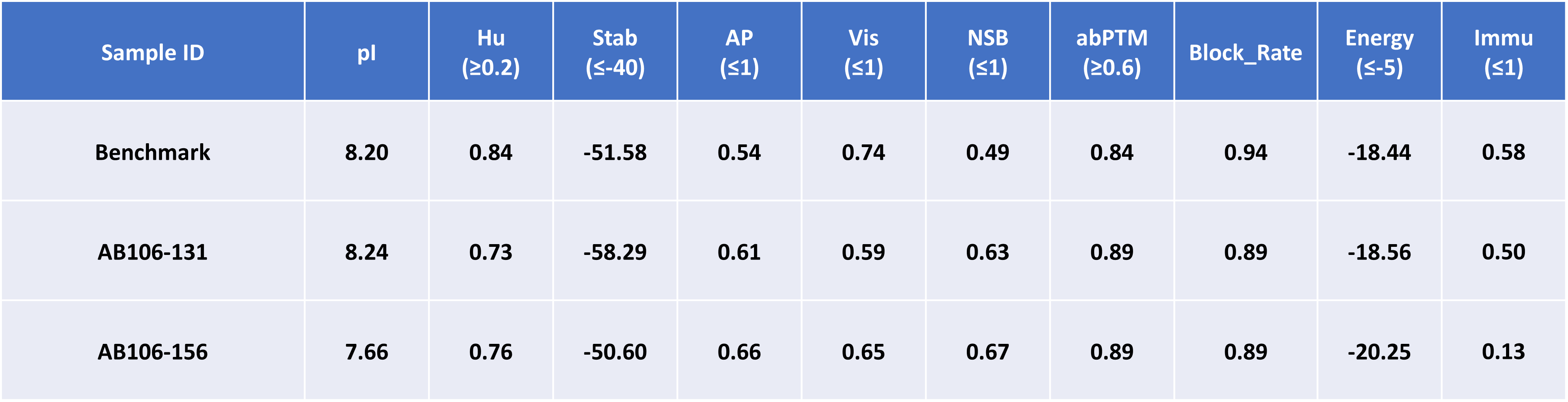
AB106-156
achieves an immunogenicity score of only 0.13, significantly outperforming the
benchmark molecule. It satisfies all criteria for molecular stability,
freeze-thaw tolerance and accelerated stability under 40°C, featuring low
aggregation propensity and compatibility with high-concentration formulations.
Supported by upfront platform evaluation, the project simultaneously advanced
CHO cell line construction, culture medium optimization and early production
process development.
Successful
validation of this workflow proves that the platform enables developability and
CMC considerations to be embedded at the design stage, helping partners prevent
project rework triggered by developability issues in later phases.
• Isoelectric
point (pI): Proteins are the most unstable and have
the lowest solubility at their pI due to the absence of charge repulsion
effects, making them prone to aggregation and precipitation.
• Humanization
score (Hu): The higher the humanization score, the
greater the degree of humanization. A score < 0.2 indicates a non-humanized
ant•ibody,
a score ranges from 0.2 to 0.6 indicates a humanized antibody, and a score >
0.6 indicates a fully humanized antibody.
• Stability
(Stab): A score > -40 indicates a risk of low molecule
stability.
• Aggregation
and precipitation (AP): A score > 1 indicates a risk of
aggregation and precipitation.
• Viscosity
score (Vis): A score > 1 suggests a risk of
excessive viscosity at high concentration (> 150 mg/ml).
• Non-specific
binding (NSB): A score > 1 indicates a tendency
towards non-specific binding.
• Antibody-antigen
predicted template modelling score (abPTM): A score < 0.6
indicates that the predicted structure is not reliable. The higher the abPTM,
the higher accuracy in the antigen-antibody docking prediction.
• Blocking
rate (block_rate): The blocking rate describes the overlap
exists between the epitopes of a ligand and an antibody on the same antigen.
• Binding
energy (Energy): A binding energy > -5 suggests a high
binding energy between the target and the predicted antibody structure,
indicating potential inaccuracy in the predicted antibody structure.
• Immunogenicity
score (Immu): A score > 1 indicates a risk of high
immunogenicity (ADA >5%).
In Vivo Efficacy Validates the Strength of the AI
Platform
AB106-156
designed via AlfaBodY demonstrates core advantages absent from current
mainstream weight-loss therapeutics when tested in the hGIPR DIO obese mouse
model:
1.
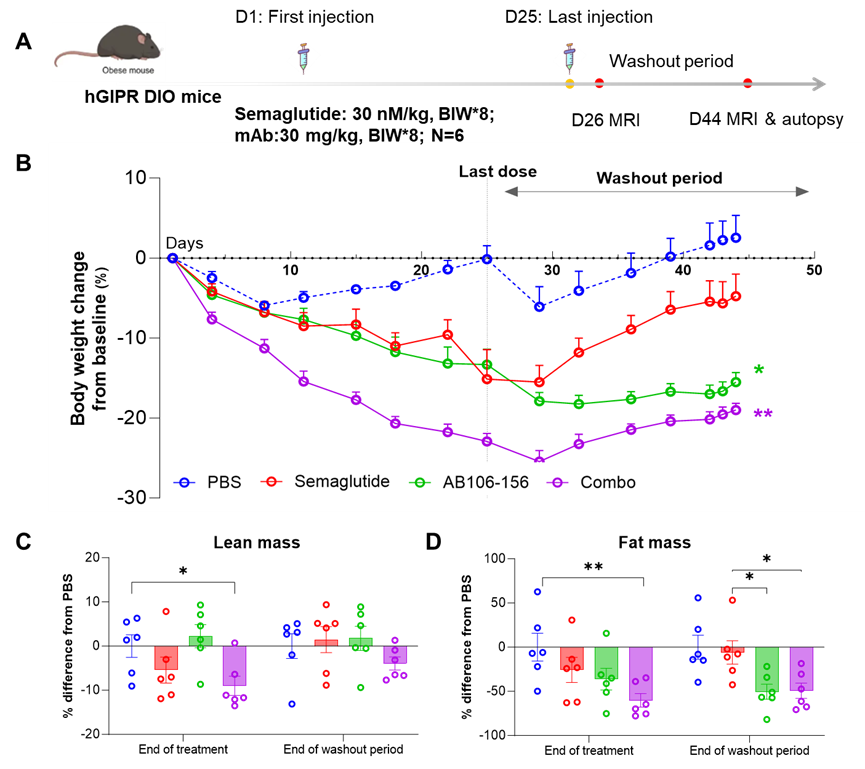
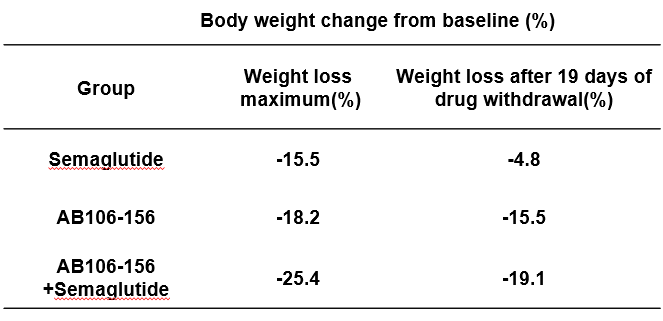
Potent weight reduction and synergistic efficacy in combination: Monotherapy
with AB106-156 delivered a maximum weight loss of 18.2%, superior to
semaglutide’s 15.5%. Combined administration achieved peak weight loss of
25.4%, showing remarkable synergistic effects via dual-pathway modulation.
2.
No weight rebound after treatment cessation for sustained metabolic stability:
During the 19-day recovery phase following drug withdrawal, the semaglutide
group exhibited a notable weight rebound of 10.7%, whereas the AI-generated
AB106-156 only rebounded by 2.7%, with continuous improvement in glycemic
control after treatment stop.

3.
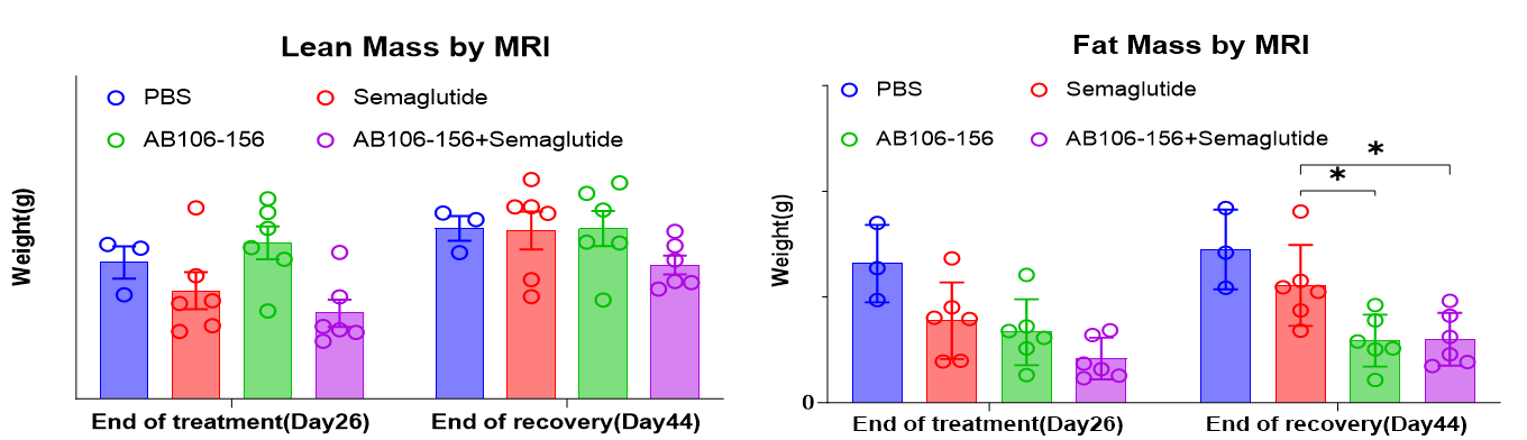
Selective fat loss with preserved lean mass: MRI body composition analysis
revealed that weight loss induced by semaglutide was accompanied by lean mass
loss and rapid fat regain after drug withdrawal. AB106-156 selectively consumes
adipose tissue with nearly no loss of lean mass, enabling long-term improvement
of body composition.
Horizontal Benchmarking of Same-Target Programs
A
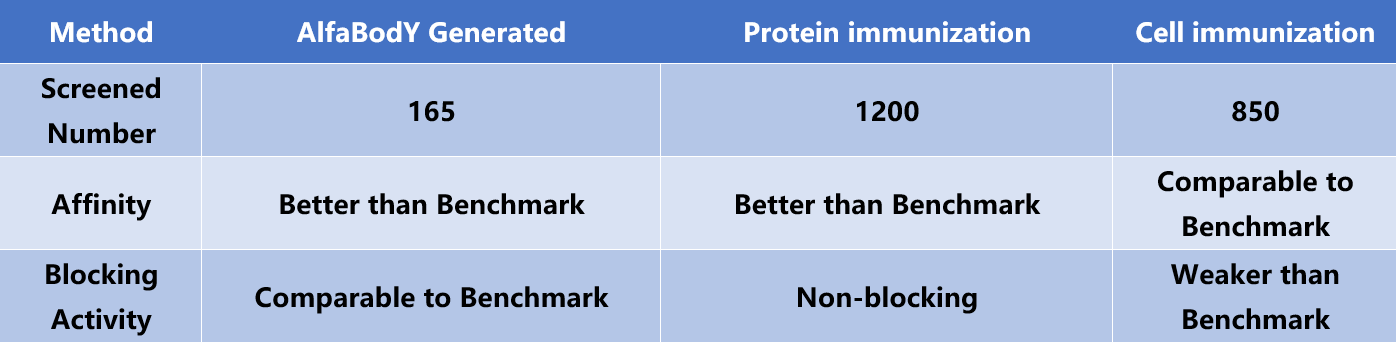
conventional CRO screened over 2,000 molecules via protein and cellular
immunization. Although molecules with affinity close to the benchmark were
obtained, their cellular function remained inferior to the benchmark even after
affinity maturation; some exhibited no blocking activity at all.
In
contrast to the two-year development cycle of traditional technologies, the
AlfaBodY platform generated and validated high-quality GIPR molecules within 8
months. This complete development case intuitively illustrates the disruptive
empowering effect of AI on original innovative drug discovery, highlighting the
platform’s strengths in accelerating progress, improving quality and enabling
differentiated innovation.
As
a leading provider of AI macromolecular design platforms in the industry, Great
Bay Bio will continue to leverage the AlfaBodY intelligent molecular design
platform. Through diversified collaboration models including platform
licensing, co-development and technical services, we aim to support global
pharmaceutical enterprises and research institutions in tackling challenging
targets such as various GPCRs and transmembrane proteins, and accelerate the
delivery of more globally competitive innovative medicines.

Technology Platform | AlfaBodY Intelligent Molecular Design Platform Powers New Drug R&D: Deliver PCC+ in 8 Months and Conquer Hard-to-Drug Targets
2026-06-25

Tech Platform | AlfaDAX Platform Iteratively Optimizes Nanobodies, Delivering a 10-Fold Affinity Improvement in 1.5 Months
2026-06-10

Technology Platform | AI-Enabled Antibody Molecular Engineering: Iterative Optimization of the AlfaDAX Platform Breaks Through Traditional R&D Bottlenecks
2026-06-03

