In the fiercely competitive biopharmaceutical industry, cell line development serves as a critical bottleneck linking drug research and development (R&D) with industrial mass production. The duration of cell line development directly determines the industrialization efficiency, cost control level, and commercial success of biopharmaceutical projects. Conventional cell line development has long been trapped in three core industry pain points: long development cycles, high costs, and high risks. Protracted R&D processes not only prolong overall project progress and consume substantial R&D resources but also lead to missed market windows and increased project uncertainty, severely restricting the industrialization and commercialization of biopharmaceutical products. The iterative upgrading of rapid cell line development systems delivers value far beyond mere time savings. By streamlining workflows, enabling precise clone screening, and advancing quality control, this technology systematically addresses the three major industry pain points, opens up the full-chain pathway from R&D and industrial production to commercial launch, and has become a core driver for accelerating project progress and capturing market share in biopharmaceuticals.

Unlike basic laboratory research, commercial cell line development prioritizes industrialization capabilities characterized by “speed, accuracy, and stability”. Traditional approaches rely on random gene integration, multiple rounds of screening, and repetitive passage verification, typically requiring 4 to 6 months or even longer to complete the entire process. Excessively long development cycles are the root cause of most industrial challenges, triggering a chain of negative outcomes: cumulative R&D costs, delayed process iteration, postponed clinical and launch timelines, and diminished market competitiveness. It is evident that the cycle bottleneck in cell line development is the primary bottleneck for biopharmaceutical industrialization and commercialization. Only by accelerating development can the three major industry pain points be fundamentally resolved and high-efficiency industrial development be empowered.
Resolving Long-Cycle Pain Points: Compressing R&D Timelines to Unlock Industrialization
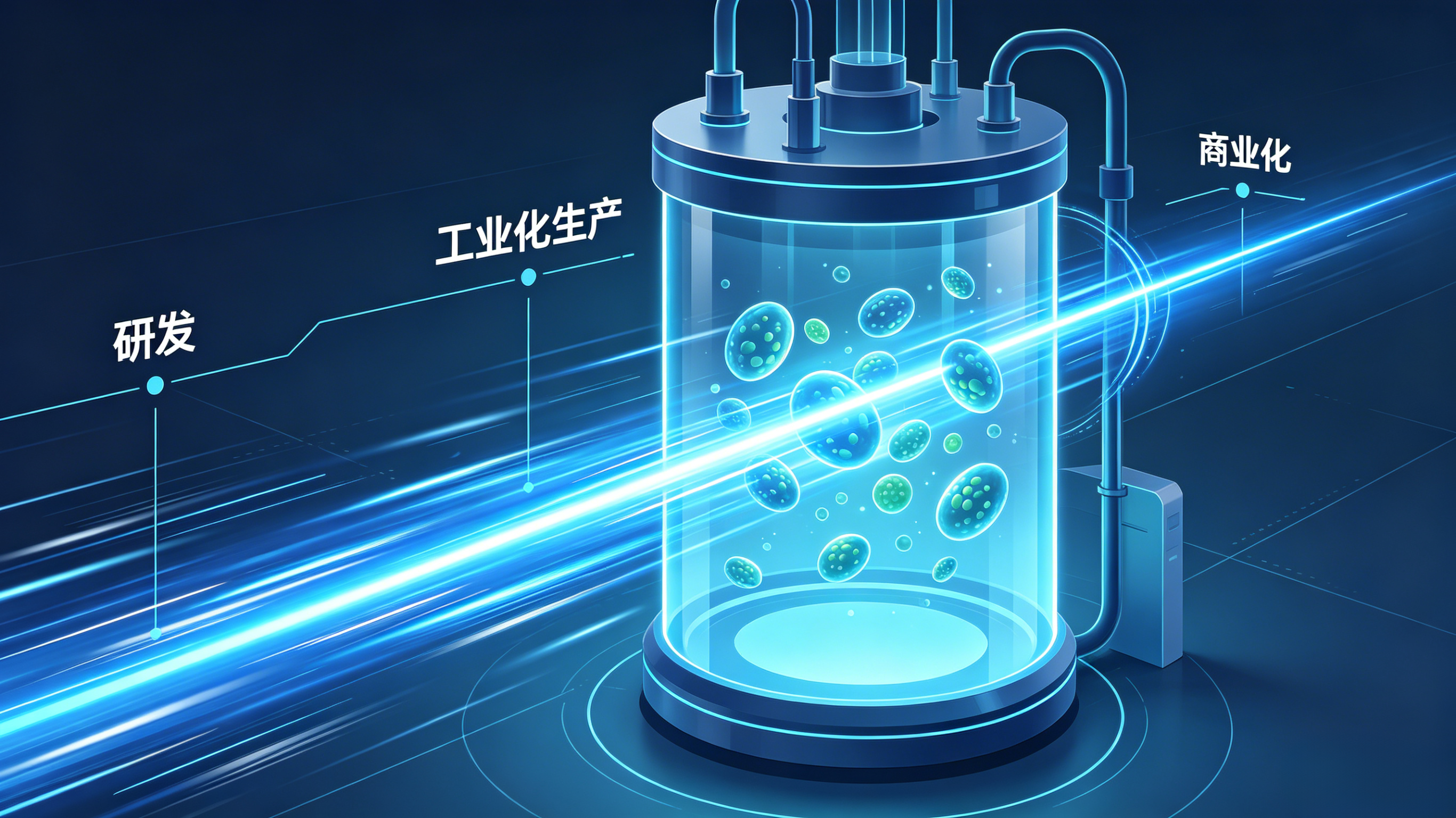
The core prerequisites for industrial production are rapid prototyping, timely verification, and seamless scale-up. However, the lengthy cycles of conventional cell line development hinder the translation of laboratory achievements into industrial production. Traditional workflows involve cumbersome procedures, including cell transfection, cell pool screening, monoclonal picking, multi-round expression verification, long-term passage stability evaluation, and cell bank construction. A substantial amount of time is wasted on inefficient clone screening and repetitive validation, resulting in delayed clone confirmation, locked process parameters, and postponed production scale-up.
Prolonged development cycles disrupt industrialization rhythms. The failure to rapidly identify optimal clones in the early R&D stage delays the synchronous advancement of follow-up industrialization work, including medium optimization, process parameter tuning, and scale-up verification, stagnating the entire R&D pipeline. In highly competitive tracks such as innovative drugs, biosimilars, and modified drugs, even minor gaps in development timelines can lead to delayed product launches and lost market share.
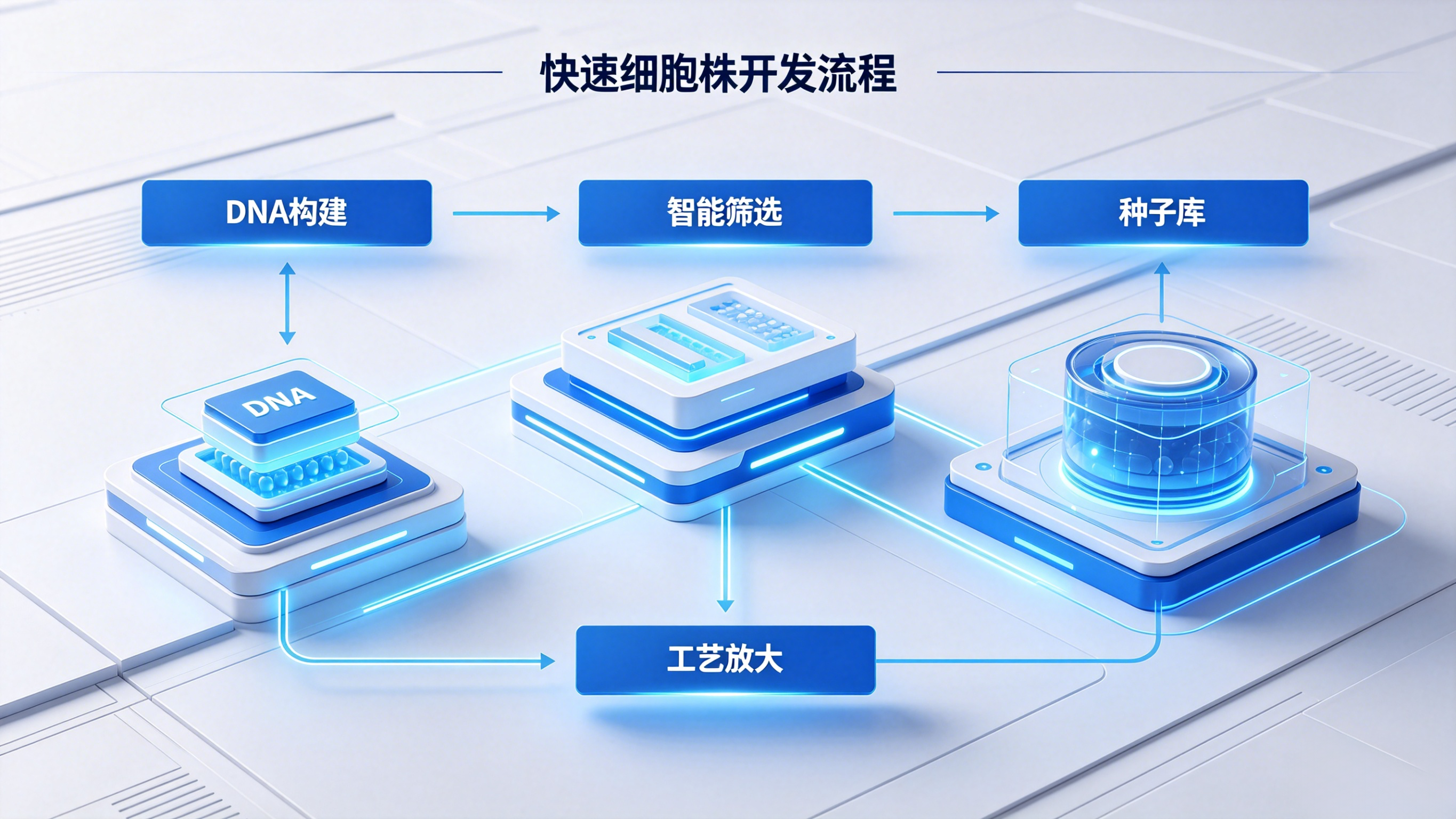
Rapid cell line development systems adopt technical logic featuring precise integration, intelligent screening, and workflow simplification, greatly eliminating ineffective cycles and compressing the traditional multi-month development process into 1–3 months, enabling fast delivery of qualified master cell banks from DNA construction. By conducting pre-judgment of stability at an early stage, eliminating low-efficiency clones, and simplifying redundant verification steps, the system ensures high cell line quality while accelerating progress. Shortened development cycles fundamentally solve the problem of delayed industrialization and achieve efficient docking between R&D and industrial production, enabling cell lines to rapidly meet the requirements for large-scale manufacturing.
Resolving High-Cost Pain Points: Streamlining R&D Workflows to Achieve Commercial Cost Reduction and Efficiency Improvement
Biopharmaceutical R&D and industrialization incur extremely high costs, and long-cycle cell line development is one of the core cost drivers, with a direct positive correlation between development duration and overall expenditure. Extended cycles lead to continuous accumulation of fixed and variable costs, including cell culture, reagents and consumables, equipment operation, manpower, and site occupancy. Furthermore, repeated screening, iterative process debugging, and trial production caused by lengthy workflows further increase material and time costs, resulting in uncontrollable early-stage project investment.
From a commercial perspective, time equates to cost and profit. Conventional long-cycle development delays capital recovery and continuously raises capital occupation costs and opportunity costs. For small and medium-sized biotech enterprises, excessive R&D cycles and capital pressure may even lead to project suspension. In addition, prolonged workflows delay the entire chain of clinical application, clinical trials, and product launch, compressing the patent lifecycle, shortening the commercial profit cycle, and significantly reducing the overall return on investment of projects.
Rapid cell line development realizes source-end cost reduction and efficiency improvement. On the one hand, it streamlines development procedures, reduces ineffective trial and error, and cuts down consumable and equipment operation costs to avoid resource waste. On the other hand, it rapidly identifies qualified cell lines and locks production processes in advance, shortening overall project cycles and accelerating capital recovery. Meanwhile, high-efficiency development reduces hidden costs caused by process rework and batch scrapping. Cycle compression enables cost controllability, and efficient development enhances the commercial cost-performance of projects, transforming biopharmaceutical industrialization from a “high-investment, slow-return” model to a “low-loss, fast-monetization” model.
Resolving High-Risk Pain Points: Advancing Risk Control to Secure Commercial Certainty

Traditional long-cycle cell line development is not only time-consuming and labor-intensive but also accompanied by high industrial and commercial risks. Longer development cycles bring higher uncertainty and a greater probability of project failure. During prolonged screening and passaging, cell lines are prone to gene silencing, expression drift, insufficient stability, and abnormal quality attributes. Defects are often exposed in the late development stage or even during process scale-up, invalidating all early R&D investment and forcing project restart and rework.
Moreover, extended development windows increase exposure to external risks, including changes in market policies, competitive landscapes, and clinical demands. Project delays not only result in missed market opportunities but also trigger multiple risks such as patent expiration, intensified industry competition, and policy adjustments, hindering commercialization. In addition, late detection of cell line defects leads to project delays and process rework, increasing regulatory risks and postponing IND and BLA submissions, which severely obstruct compliant product launches.
Rapid cell line development pursues balanced progress rather than blind speed, achieving risk control and quality assurance amid accelerated development. Through early clone screening, pre-judgment of stability, and synchronous quality verification, high-risk, low-expression, and unstable clones are eliminated in the early development stage, avoiding potential hazards in subsequent process scale-up and regulatory submission. Short and efficient development cycles greatly reduce project uncertainty, mitigate quality drift risks caused by long-term cell passaging, ensure on-time project declaration and product launch, and maximize commercial certainty.
In summary, the speed of cell line development is far more than an efficiency indicator; it is a core determinant of industrialization implementation, cost control, risk management, and commercial monetization. The long cycles of traditional development trigger the industry’s triple dilemmas of high cost, high risk, and low efficiency, restricting industrial upgrading of biopharmaceuticals. In contrast, rapid cell line development takes acceleration as the core breakthrough point to systematically address industry pain points: shortened cycles pave the way for large-scale industrial production, high efficiency enables commercial cost reduction, and advanced risk control guarantees project implementation certainty.
Against the backdrop of rapid industry iteration and fierce market competition, efficient and controllable cell line development has become a core competitiveness of biopharmaceutical enterprises. Continuous optimization of rapid cell line development systems that balance speed, quality, and stability can accelerate R&D progress, stabilize industrial processes, control overall costs, and mitigate project risks, ultimately empowering standardized industrial production and efficient commercialization of biopharmaceutical products.