In antibody drug development, optimizing candidate molecules using traditional approaches often encounters bottlenecks: conventional random library construction and screening methods have limited remaining potential, affinity is difficult to further improve, and issues such as high viscosity, aggregation propensity, and suboptimal developability cannot be addressed simultaneously. The AlfaDAX intelligent molecular evaluation and optimization platform developed by Great Bay Bio provides an AI-driven end-to-end solution of “sequence input – intelligent assessment – precise optimization.” It rapidly predicts key druggability parameters including isoelectric point, humanization score, immunogenicity, stability, aggregation/precipitation risk, etc. It disruptively enables simultaneous three-dimensional optimization of affinity, humanization, and developability, helping clients shorten R&D timelines, reduce risk, and generate clinical-grade candidate molecules.
Recently, the AlfaDAX platform has been validated in client programs facing development bottlenecks, further demonstrating its three core strengths: “intelligent prediction, three-dimensional simultaneous optimization, and low-cost efficient iteration.” Real-world data highlight its value and set a new benchmark for success rates in AI-enabled drug molecule development.

▲ Intelligent Molecular Evaluation and Optimization Platform (AlfaDAX)
1. High-precision intelligent prediction to proactively avoid development risks
AlfaDAX builds a systematic intelligent evaluation model that predicts, at the early stage of sequence optimization, a full spectrum of developability and safety-related properties, including humanization, immunogenicity, viscosity, aggregation risk, expression level, protein degradation, and nonspecific binding. It identifies defective residues in advance and defines optimization directions at the source, avoiding unnecessary sequence synthesis and potential downstream clinical development risks.
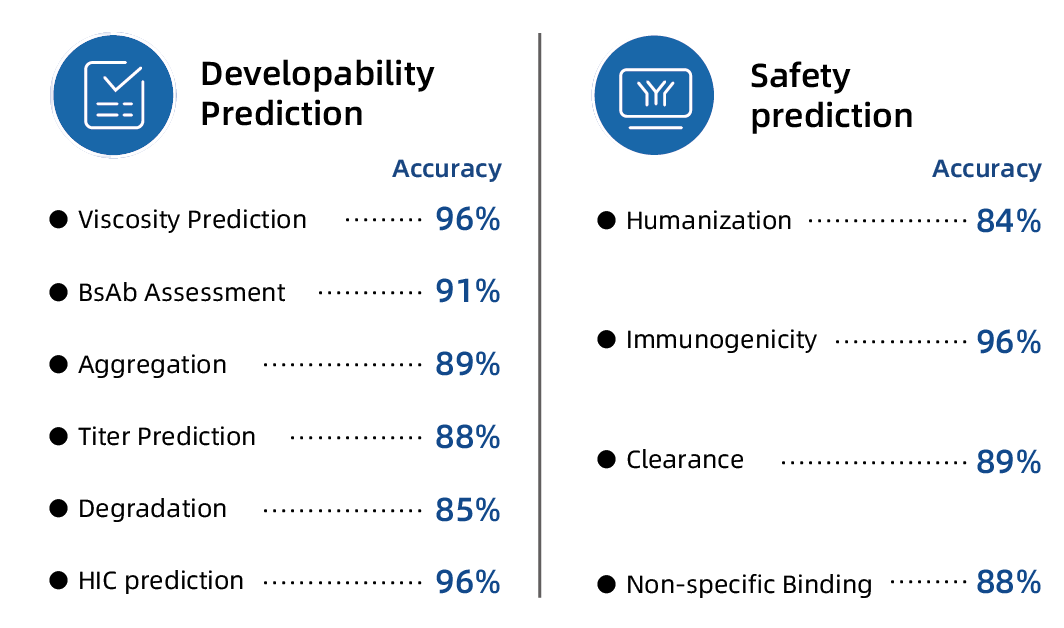
▲ Prediction accuracy of developability and safety using the AlfaDAX platform:
Developability prediction accuracy:
Viscosity: 96%
Bispecific antibody developability: 91%
Aggregation/solubility: 89%
Expression level: 88%
Protein degradation: 85%
Hydrophilicity/hydrophobicity: 96%
Safety prediction accuracy:
Humanization score: 84%
Immunogenicity: 96%
Clearance rate: 89%
Nonspecific binding: 88%
2. Rapid iterative optimization breaking through traditional limits
A client monoclonal antibody project had already reached a bottleneck using traditional library-based optimization methods and still could not meet project requirements. After introducing the AlfaDAX platform, three rounds of AI-guided targeted optimization were conducted. Each round showed steady improvements in activity while simultaneously enhancing developability.
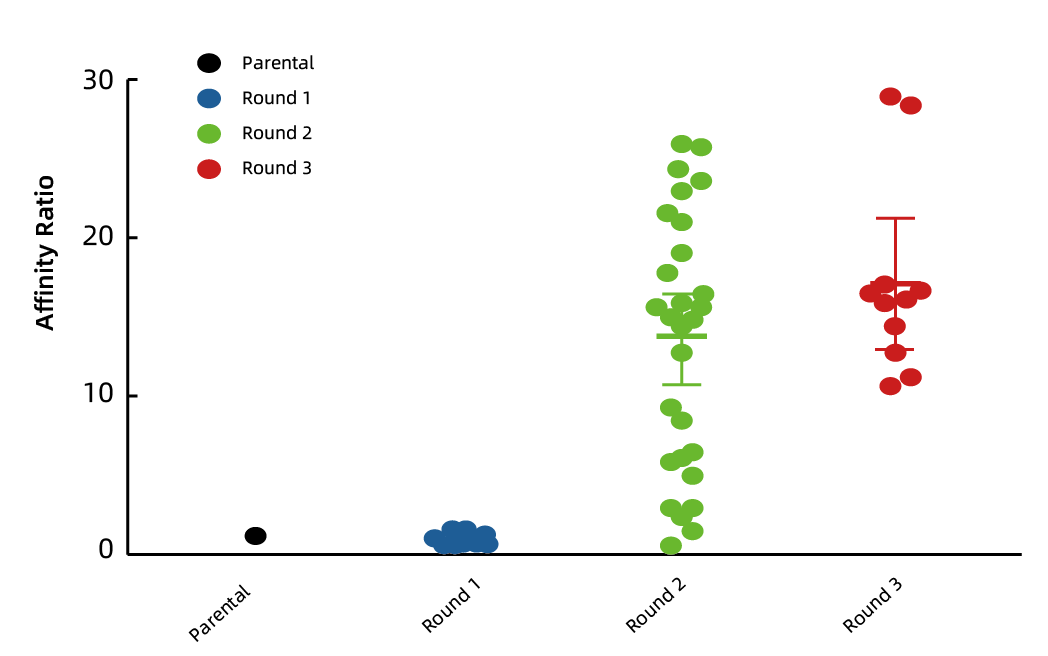
▲ Three rounds of AI-guided optimization using the AlfaDAX platform
The total number of synthesized sequences across the entire optimization cycle was kept to fewer than 100, far below the tens of thousands typically required in traditional library screening. This dramatically reduced reagent consumption and screening costs.
Affinity improved dramatically: after two rounds of optimization, affinity increased more than 20-fold compared to the parent molecule; after three rounds, improvements reached nearly 30-fold at best, surpassing traditional screening performance limits.
Multi-parameter co-optimization was achieved: affinity increased progressively across iterations (Parent → Round 1 → Round 2 → Round 3), with steady improvement while maintaining balanced developability.
3. Simultaneous three-dimensional optimization of affinity, humanization, and developability
Traditional workflows typically follow a sequential process: first affinity maturation, then humanization, and finally physicochemical developability optimization. This stepwise approach is time-consuming, and improvements in one dimension often compromise others, creating a “fix one issue, break another” problem.
AlfaDAX fundamentally disrupts this paradigm by enabling simultaneous optimization of all three properties. While improving molecular activity, it concurrently enhances viscosity, aggregation propensity, nonspecific binding, and other developability-related characteristics, overcoming the industry challenge where “increasing activity worsens physicochemical properties.”
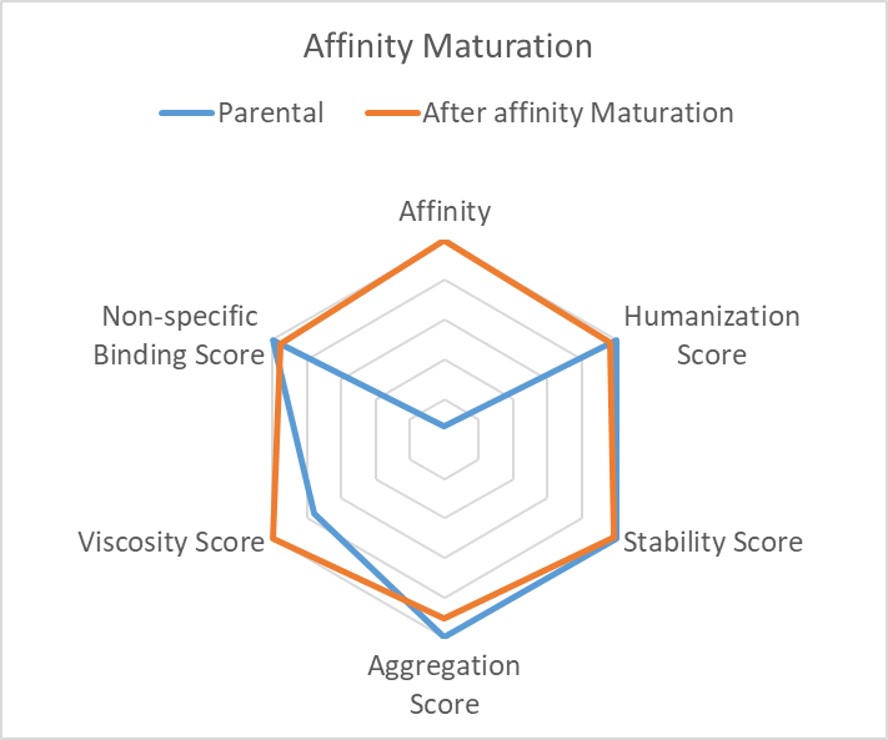
▲ Orange optimized molecules (Affinity Maturation) compared with the blue parent sequence show multi-dimensional improvements across six key metrics: affinity, humanization, stability, aggregation, viscosity, and nonspecific binding.
With the AlfaDAX intelligent optimization system, pharmaceutical companies can move beyond the inefficient traditional workflow of “first improve affinity, then fix developability defects.” This significantly shortens molecular optimization timelines, reduces costs and time lost in blind screening, and enables earlier identification of low-risk, high-activity, high-expression clinical candidate molecules—supporting more efficient advancement of innovative drug pipelines.