Great Bay Bio’s proprietary AlfaCell Fluorescence-Guided Targeted Integration Cell Line Development Platform addresses key limitations of conventional random integration, including lengthy development timelines, labor-intensive clone screening, and unstable expression. It accelerates CMC development and commercialization of complex biologics, including monoclonal antibodies (mAbs), bispecific antibodies (BsAbs), multispecific antibodies, antibody-drug conjugates (ADCs), and Fc-fusion proteins.
In this article, we address some of the most frequently asked questions in the industry to help you better understand the application scope of the AlfaCell platform and explore real-world customer case studies.
Q1: What types of biologic molecules does AlfaCell support?
AlfaCell supports multiple biologic molecule types, including:
• Monoclonal antibodies (mAbs);
• Bispecific antibodies;
• Multispecific antibodies;
• ADC-related antibodies;
• Fc-fusion proteins;
• Other recombinant proteins.
Public cases show AlfaCell has been applied to cell line development for molecules of varying complexity.
Q2: Does AlfaCell support complex molecule development such as bispecific and multispecific antibodies?
Yes.
Complex molecules such as bispecific and multispecific antibodies typically face challenges including:
• Difficulty in coordinating multi-chain expression;
• Insufficient chain-pairing efficiency;
• Complex product quality control.
AlfaCell has completed multiple complex-antibody projects, e.g., both bispecific and multispecific antibody projects achieved stable expression. In public cases, bispecific/multispecific projects reached an average titer of 5.6 g/L, and complex-structure bispecific projects reached fed-batch titers above 6.4 g/L.
Q3: Does AlfaCell support biosimilar development?
Yes.
AlfaCell can be applied to stable cell line development for biosimilar projects, establishing high-expression production cell lines through SSI and high-throughput screening. The platform is suitable for the R&D needs of various antibody and recombinant-protein biosimilars.
Q4: Has AlfaCell been validated by real customer projects?
Yes.
AlfaCell has completed multiple customer projects covering:
• mAbs;
• Bispecific antibodies;
• Multispecific antibodies;
• Fc-fusion proteins;
• Complex-structure proteins.
Public case data show that the 12 most recent customer projects spanning different product types achieved an average titer exceeding 6.9 g/L.
Q5: What are the expression levels of AlfaCell customer projects?
Expression levels of different molecule types are affected by molecular structure, host cell, and culture process. According to public cases:
• mAb projects: average titer approx. 8.1 g/L;
• Bispecific/multispecific projects: average titer approx. 5.6 g/L;
• Fc-fusion protein projects: average titer approx. 10.0 g/L.
Q6: Does AlfaCell have successful cases with complex molecules?
Yes.
Public cases show:
• A four-chain bispecific antibody project completed cell line development in about 3 months at a titer of 8.3 g/L;
• A nanobody-derived bispecific antibody project reached a titer of 15.6 g/L;
• A bispecific antibody project obtained a stable cell line in as fast as about 1.5 months at a titer above 4 g/L.
These cases demonstrate AlfaCell's ability to support structurally complex molecule development.
Q7: Have AlfaCell SSI cell lines been validated in clinical-stage projects?
Public cases show that a customer innovative-drug project using AlfaCell-developed cell lines has achieved out-licensing and advanced to Phase II clinical stage, while also receiving FDA Fast Track Designation.
This case indicates that AlfaCell-developed cell lines can meet the quality and stability requirements of innovative biologic projects throughout early R&D, cell line development, and clinical-stage advancement.
Because innovative-drug projects involve customer trade secrets, specific customer names, product information, and detailed development data are disclosed only upon customer authorization.
Q8: Does AlfaCell support IND filing?
Yes.
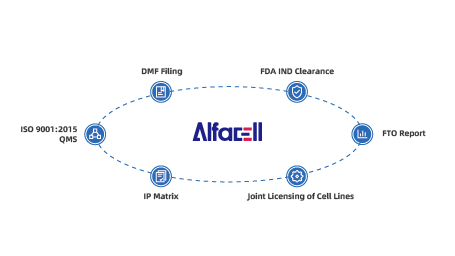
AlfaCell has completed FDA Drug Master File (DMF) filing, DMF number 038272. When customers use AlfaCell-developed cell lines for new-drug registration, relevant DMF information can be referenced per regulatory requirements to support IND filing.
Q9: Does AlfaCell own intellectual property?
Yes.
AlfaCell's integration hotspot within our host cell line is protected by patents filed in multiple countries. An authoritative IP law firm issued a Freedom to Operate (FTO) analysis, confirming that this integration hotspot and its related elements are freely implementable.