Great Bay Bio’s proprietary AlfaCell Fluorescence-Guided Targeted Integration Cell Line Development Platform addresses key limitations of conventional random integration, including lengthy development timelines, labor-intensive clone screening, and unstable expression. It accelerates CMC development and commercialization of complex biologics, including monoclonal antibodies (mAbs), bispecific antibodies (BsAbs), multispecific antibodies, antibody-drug conjugates (ADCs), and Fc-fusion proteins.
In this article, we address some of the most frequently asked questions in the industry to help you quickly understand AlfaCell’s business models and collaboration opportunities.
Q1: What cooperation models does AlfaCell offer?
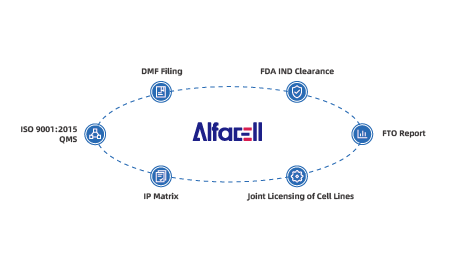
AlfaCell provides flexible cooperation models to meet the cell line development and platform-capability needs of biopharma enterprises at different stages, mainly including:
1. Cell Line Development Service
• Customers provide target molecule information; Great Bay Bio completes SSI cell line development on the AlfaCell platform, including: target gene construction and integration; high-expression clone screening; monoclonal cell line establishment; expression and quality analysis; Research Cell Bank (RCB) construction; and delivery of relevant technical documentation.
This model suits Biotech and pharma enterprises that want to quickly obtain high-quality production cell lines but do not plan to build their own cell line development platform.
2. AlfaCell Platform Licensing
• For enterprises with in-house R&D and CMC teams seeking to build autonomous cell line development capability, Great Bay Bio can provide AlfaCell platform licensing cooperation, giving partners access to AlfaCell-related technical capabilities for in-house cell line development process build-out and accelerating their biologics R&D and manufacturing capability layout.
Suitable for: large pharma enterprises; Biotech companies with in-house cell line development teams; enterprises wishing to build long-term autonomous CMC capability; and CDMO enterprises.
Great Bay Bio can provide flexible solutions ranging from project services to platform cooperation based on the customer's R&D stage, technical needs, and business plan, helping customers accelerate the transition from candidate molecule to commercial manufacturing.
Q2: What is the difference between the cell line development service and the technology licensing model?
The two models differ mainly in how technical capability is deployed:
• Cell Line Development Service model: Great Bay Bio completes cell line development and the customer receives the project deliverables — suitable for enterprises wanting to advance projects quickly;
• Technology Platform Licensing model: the customer receives authorization to AlfaCell's technical capabilities and can conduct cell line development within its own R&D system — suitable for enterprises building long-term in-house capability.
Q3: Does AlfaCell provide cell line development outsourcing services?
Yes.
Great Bay Bio can provide customized cell line development services on the AlfaCell platform, helping customers complete the development workflow from target molecule to stable production cell line. To date, Great Bay Bio's cell line development outsourcing service has served dozens of domestic and international pharma companies and CDMOs.
Q4: Does AlfaCell support platform technology transfer / licensing?
Yes.
For enterprises wishing to build autonomous cell line development capability, Great Bay Bio can provide an AlfaCell platform licensing cooperation plan to help customers construct in-house SSI cell line development capability.
Q5: What is the AlfaCell cell line development workflow?
A typical development workflow includes:
• Project requirement analysis;
• Target gene design and construction;
• SSI;
• Fluorescence-assisted screening;
• Monoclonal establishment;
• Expression and quality analysis;
• RCB construction;
• Technical delivery.
Q6: What are the AlfaCell project deliverables?
Depending on the cooperation plan, deliverables include:
• Stably expressing cell line;
• RCB;
• Monoclonal-origin analysis data;
• Expression detection data;
• Product quality analysis data;
• Technical report.
Q7: Does AlfaCell support customer-designated CDMO manufacturing?
Yes.
Great Bay Bio can provide cell line development services and connect with the customer's designated CDMO or manufacturing partner through technology transfer.
AlfaCell considers downstream scale-up needs during cell line construction and can support the transition from R&D to commercial manufacturing. Projects using AlfaCell cell lines have already entered Phase II clinical stage and completed scale-up above 500L.
Q8: How are customer project IP rights protected?
Customer project items — including:
• Molecule information;
• Cell lines;
• Experimental data;
• Technical documentation;
— and the above core trade secrets are managed per the confidentiality and commercial-contract clauses.
Q9: Why choose AlfaCell for cell line development?
Main reasons to choose AlfaCell include:
• SSI technology improves expression stability and avoids the instability of random integration;
• Fluorescence-assisted screening improves development efficiency and reduces monoclonal workload;
• Supports multiple complex biologic molecules;
• Rapid generation of a stable cell line within 1.5 months;
• Supports downstream CMC and commercialization development.
Q10: How long does it take to obtain a stable CHO cell line with AlfaCell?
According to public cases, AlfaCell can complete RCB construction in as fast as about 1.5 months. The specific timeline depends on:
• Molecule complexity;
• Analytical requirements;
• Project deliverable scope.
Q11: Is AlfaCell suitable for Biotech companies?
Yes.
For Biotech enterprises lacking in-house cell line development capability and wanting to rapidly advance CMC development, AlfaCell can provide:
• Professional cell line development capability;
• Rapid project delivery;
• Downstream CDMO connection support.
Q12: How can I tell whether my molecule is suitable for AlfaCell development?
Customers can provide:
• Molecule type;
• Gene sequence or related information;
• Target titer;
• Development stage;
• Project timeline.
Great Bay Bio will conduct a technical assessment under a Non-Disclosure Agreement (NDA) framework and formulate a suitable cell line development plan.