Q1:
What is AlfaCell?
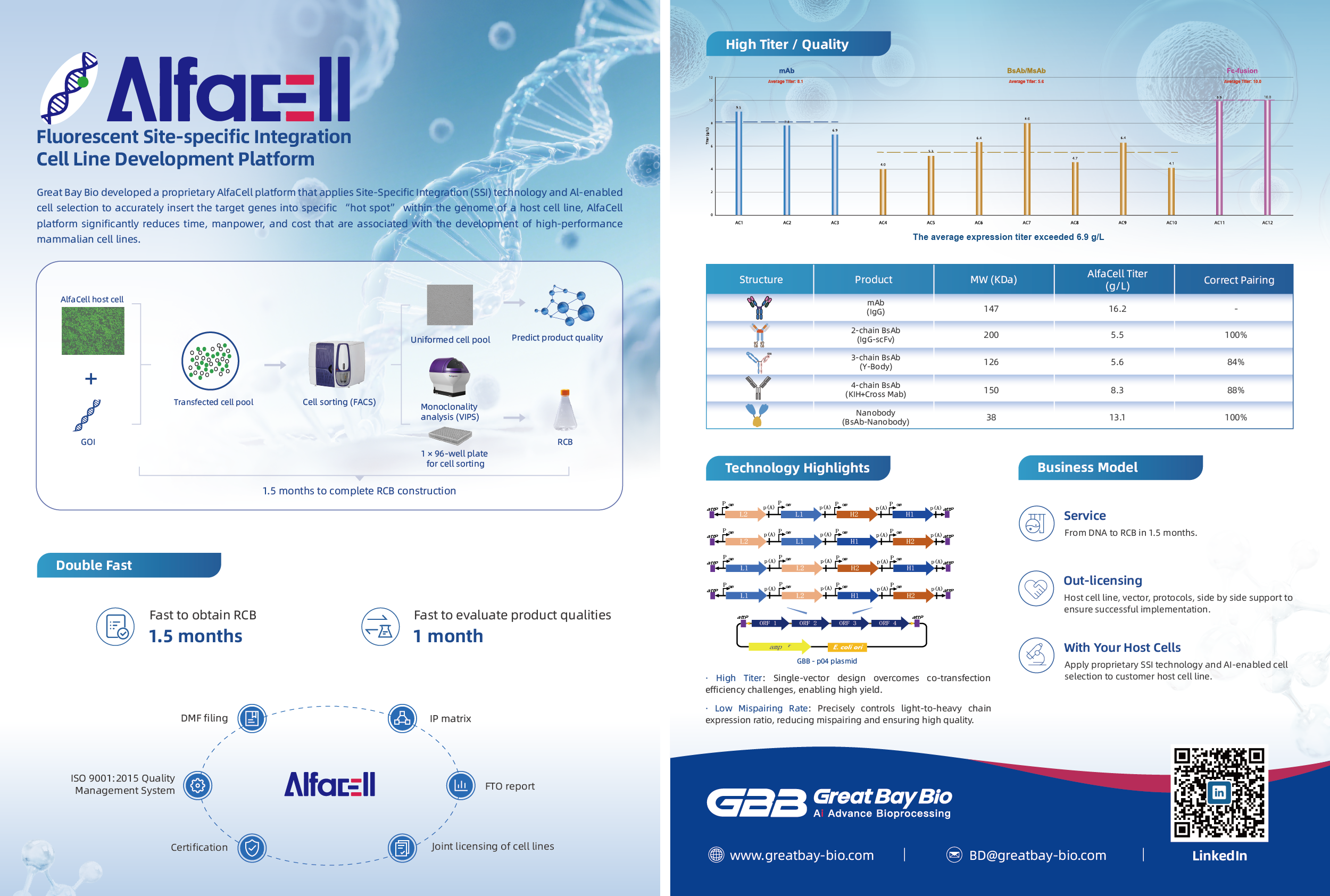
AlfaCell is a fluorescence-based
Site-Specific Integration (SSI) cell line development platform independently
developed by Great Bay Bio, focused on the rapid development of
high-expression, high-stability, and high-quality production cell lines for
biologics.
AlfaCell combines SSI technology,
fluorescence visual screening technology, and high-throughput analytical
technologies such as FACS, VIPS, and Octet to precisely integrate the target
gene into a validated, highly active expression region and rapidly screen for
stable, high-yield monoclonal cell lines.
Compared with traditional
random-integration cell line development, AlfaCell improves development
efficiency, reduces expression-variability risk, and accelerates biologics CMC
development.
Q2:
What is Site-Specific Integration (SSI) cell line development?
SSI is a genetic engineering technology
that uses site-specific recombinases to precisely insert the gene of interest
into a specific locus of the host cell chromosome. It enables the cell line to
achieve: better expression stability; higher batch-to-batch consistency; and
lower CMC development risk.
Q3:
On which host cell is AlfaCell developed? Does it support CHO cell line
development?
AlfaCell is an SSI cell line development
platform built on the CHO-K1 (Chinese Hamster Ovary-K1) cell line, dedicated to
developing high-expression, high-stability production cell lines for complex
biologics such as antibodies, bispecific antibodies, and fusion proteins.
Leveraging the mature industrial foundation
of CHO-K1, AlfaCell combines SSI technology, fluorescence visual screening, and
high-throughput monoclonal screening to achieve precise target-gene integration
and rapid screening of high-potential cell lines.
As one of the most widely used host cells
in global commercial biologics manufacturing, CHO-K1 offers: high process
maturity; rich scale-up experience; high regulatory acceptance; and
applicability to diverse recombinant protein expression.
Based on the CHO-K1 system, AlfaCell can
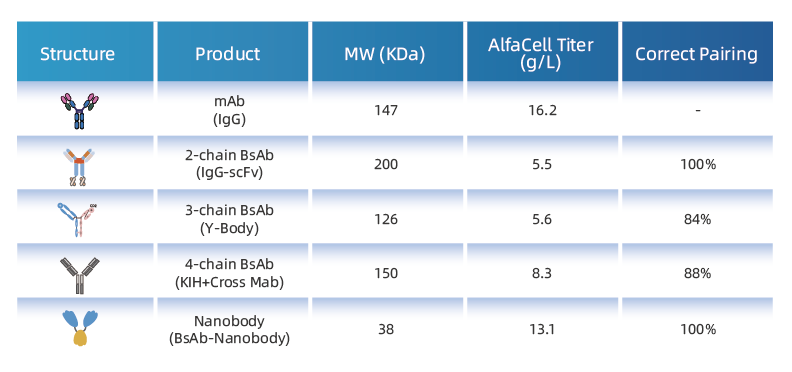
support cell line development for multiple biologic molecule types — including
mAbs, bispecific antibodies, multispecific antibodies, ADC-related antibodies,
and Fc-fusion proteins — and meets the requirements of downstream CMC
development and commercial manufacturing.
Q4:
How does AlfaCell achieve precise gene integration?
Based on the CHO-K1 host cell system,
AlfaCell employs site-specific recombinase-mediated technology to precisely
insert the target gene into a pre-designed genomic locus, achieving stable
integration and sustained expression of the exogenous gene.
Compared with traditional random
integration, by controlling the insertion position of the target gene, AlfaCell
reduces position-effect and expression-variability risks caused by random
integration-site heterogeneity, improving the stability and predictability of
cell line development.
After precise gene integration, AlfaCell
combines fluorescence visual screening, single-cell sorting, and expression
analysis to rapidly screen for high-expression, high-stability monoclonal
production cell lines.
Q5:
How does AlfaCell select the target integration site?
The core of SSI cell line development lies
in selecting genomic integration sites with good expression potential and
long-term stability, and precisely directing the target gene into that site.
Based on the CHO-K1 host system, AlfaCell
systematically evaluates genomic regions and uses AI technology and
high-throughput automated screening to identify and validate highly active
expression regions as target integration sites with the following characteristics:
· Open chromatin suitable for
accommodating long exogenous gene fragments;
· Ability to support long-term
genetic stable expression;
· Reduced risk of gene silencing
and expression fluctuation.
After the target site is determined,
AlfaCell uses site-specific recombinase-mediated technology to precisely insert
the expression cassette into the pre-validated high-expression genomic locus,
avoiding the uncontrolled insertion-position problem of traditional random
integration, which can adversely affect host cell physiology.
Subsequently, fluorescence visual
screening, single-cell sorting, and expression analysis are used to perform
high-throughput screening of the integrated cells, yielding high-expression,
high-stability candidate monoclonal cell lines.
Q6:
How does AlfaCell verify whether the target gene is precisely integrated?
AlfaCell confirms candidate cell lines
through a multi-dimensional analysis strategy, including:
· Residual fluorescent-marker
analysis;
· Gene-integration analysis;
· Monoclonal-origin confirmation;
· Exogenous-gene expression
detection;
· Protein-expression-level
analysis;
· Stability evaluation.
Combined with fluorescence screening and
high-throughput detection technologies, candidate cell lines with development
potential can be rapidly identified.
Q7:
How does AlfaCell ensure monoclonality?
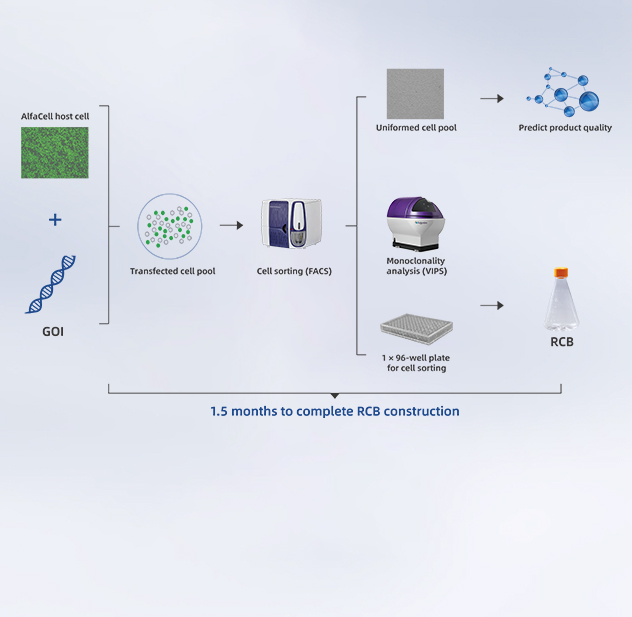
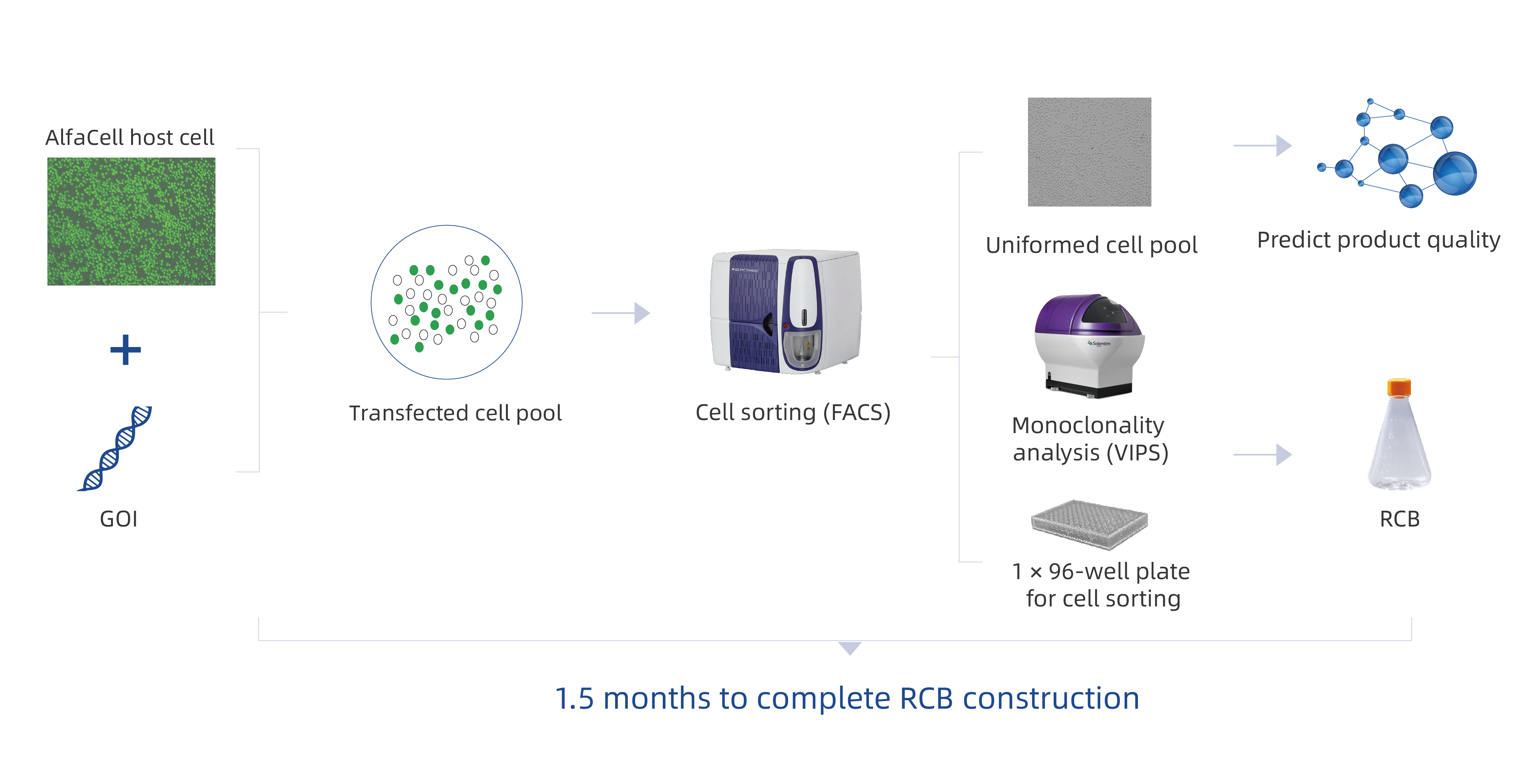
AlfaCell combines VIPS single-cell sorting
technology, monoclonal-origin analysis, and subsequent verification testing to
ensure candidate cell lines originate from a single cell clone.
Screening and analysis at the single-cell
level reduce the risk of mixed clones and provide assurance for subsequent
stable expression and production consistency.
Q8:
What are the advantages of AlfaCell's fluorescence screening technology?
AlfaCell combines fluorescence technology
with SSI technology, enabling rapid observation of target-gene integration and
expression status.
Combined with:
· FACS flow sorting;
· VIPS single-cell imaging
sorting;
· Octet protein-expression
detection;
it can rapidly identify:
· High-expression clones;
· Monoclonal-origin cells;
· Candidate cell lines with
industrial production potential.
This approach reduces the blindness of
traditional screening workflows and improves development efficiency.
Q9:
Why does SSI improve the predictability of cell line development compared with
random integration?
During random integration, the exogenous
gene may randomly enter different genomic regions, and different insertion
positions may lead to:
· High host-cell physiological
uncertainty;
· Expression-level variation;
· Gene silencing;
· Declining cell line stability.
By controlling the target-gene insertion
position, SSI standardizes the development process across different projects
and improves the predictability of cell line performance.
For commercial biologics manufacturing, a
stable and controllable integration method helps reduce downstream CMC
development risk and improve process scale-up and production consistency.
Q10:
What is the difference between AlfaCell SSI cell lines and traditional
random-integration CHO cell lines?
Traditional random-integration CHO cell
line development typically requires screening high-expression clones from a
large pool of randomly integrated clones, with problems such as long timelines,
high screening costs, and uncertain outcomes.
AlfaCell adopts an SSI strategy, directing
the target gene into a stable, high-expression region and combining
fluorescence-assisted screening to rapidly obtain high-potential clones. Key
advantages include:
· High controllability of host
cell physiology;
· Genomic stability;
· More controllable integration
sites;
· More stable expression
performance;
· Reduced large-scale blind
screening;
· Shortened cell line development
cycle.
Q11:
During cell line development, why is AlfaCell's development cycle shorter than
traditional CHO cell line development?
Traditional CHO cell line development
usually relies on random integration and extensive clone screening, requiring
the search for high-expression clones among a large candidate pool, resulting
in a longer development cycle.
Based on the CHO-K1 SSI cell line platform,
AlfaCell uses site-specific recombinase-mediated precise gene integration to
direct the target gene into predefined sites, and combines fluorescence visual
screening, single-cell sorting, and high-throughput analysis to improve
candidate-clone screening efficiency.
By reducing ineffective work in random
screening, AlfaCell can significantly shorten the cell line development cycle;
public cases show the fastest RCB (Research Cell Bank) construction in about
1.5 months.
Q12:
Why are SSI cell lines more suitable for industrial biologics manufacturing?
Industrial manufacturing requires cell
lines with long-term stable expression capability and batch-to-batch
consistency.
By reducing the position effect caused by
random insertion, SSI gives cell lines better stability and predictability
during:
· Host-cell physiological
control;
· Genomic stability;
· Long-term passage;
· Process scale-up;
· Production batch changeover.
Therefore, SSI has become an important
technology direction for the development of next-generation high-quality
production cell lines.
Q13:
Can cell lines developed with AlfaCell undergo long-term stability studies?
Yes.
Based on SSI technology, by controlling the
target-gene insertion position, AlfaCell reduces the expression-fluctuation and
gene-silencing risks caused by insertion-site differences in traditional random
integration, improving the predictability of long-term stable expression from
the source.
During cell line development, AlfaCell
performs long-term stability assessment of candidate cell lines through
stability evaluation, expression-level analysis, and continuous passage
observation.
By monitoring the cell line during
continuous culture — including:
· Expression maintenance
capability;
· Cell growth characteristics;
· Product quality attribute
changes;
AlfaCell evaluates the cell line's
long-term production potential, providing data support for downstream CMC
development, process scale-up, and commercial manufacturing.
Q14:
Do cell lines developed with AlfaCell require long-term drug pressure?
No.
Compared with other cell line construction
methods (which require long-term drug selective pressure to maintain the
stability of the integrated exogenous gene), AlfaCell-built cell lines are
selected for the integrated gene using only 48 hours of hygromycin pressure
during the transfection stage. After sorting into plates and expansion to the
RCB stage, no further drug pressure is needed. The AlfaCell-derived RCB can be
used directly to establish the Master Cell Bank (MCB).
Q15:
Can AlfaCell reduce CMC development risk?
Yes.
Through SSI, stable-expression screening,
and early quality analysis, AlfaCell can help customers:
· Assess expression potential
earlier;
· Reduce cell-line instability
risk;
· Identify development issues
sooner.